A private lovo feast at Ucuilagi: Fijian culture on your own doorstep
One of the most common things guests say after a stay at Ucuilagi is that the lovo was one of the highlights of the trip. Not the diving, not the views, not the waterfall walks, though all of those are remarkable. The lovo. A traditional Fijian feast prepared in a pit in the gardens by Isoa and his family, eaten on the deck as the sun goes down over the Somosomo Strait.
For many international visitors, it is their first real encounter with Fijian culture as it is actually lived, not a performance staged for tourists, but the real thing, prepared by people who grew up doing it this way. That difference is felt immediately and remembered long after everything else fades.
This article explains what a lovo is, what the evening involves at Ucuilagi, and what else guests can explore of Fijian culture during a stay on Taveuni Island.
Fijian words worth knowing
Lovo: A traditional underground feast, cooked on hot stones in an earth pit. The Fijian equivalent of a hangi (New Zealand) or imu (Hawaii).
Meke: Traditional Fijian song and dance, performed to tell stories of history, legend, and daily life.
Kava (yaqona): A mildly sedative drink made from the root of the kava plant, central to Fijian ceremony and social life.
Sevusevu: A gift of kava presented to a village chief as a gesture of respect when visiting.
Bula: The Fijian greeting, used for hello, goodbye, cheers, and almost everything in between.
Vinaka: Thank you.
What is a lovo?
A lovo is a method of cooking that has been used across the Pacific for centuries. A pit is dug in the earth and lined with stones, which are heated over a fire until they are intensely hot. Food is wrapped in banana leaves (whole fish, root vegetables, meat, coconut-based dishes) and placed directly onto the stones. The pit is then covered with more banana leaves, earth, and sometimes hessian sacking to trap the heat, and left to cook slowly for several hours.
The result is something distinct from any other cooking method. The food takes on a subtle earthiness from the banana leaves and the slow, sealed heat. Fish falls apart. Root vegetables (taro, cassava, kumala) become dense and flavourful. Everything arrives at the table at once, in the way a feast should.
In Fijian culture, a lovo is not everyday cooking. It is reserved for celebrations, community gatherings, weddings, and significant occasions. To be included in one is to be welcomed into something that matters.
The lovo at Ucuilagi
At Ucuilagi, the lovo pit is in the gardens of the property. Isoa's family, his brothers, cousins, and the boys from his community, come together to prepare it, the way they have always prepared it. Guests are welcome to watch the whole process from the beginning: the fire, the stones, the wrapping of food in banana leaves, the slow covering of the pit. It is an hour or two of unhurried, communal work, and watching it is itself a significant part of the experience.
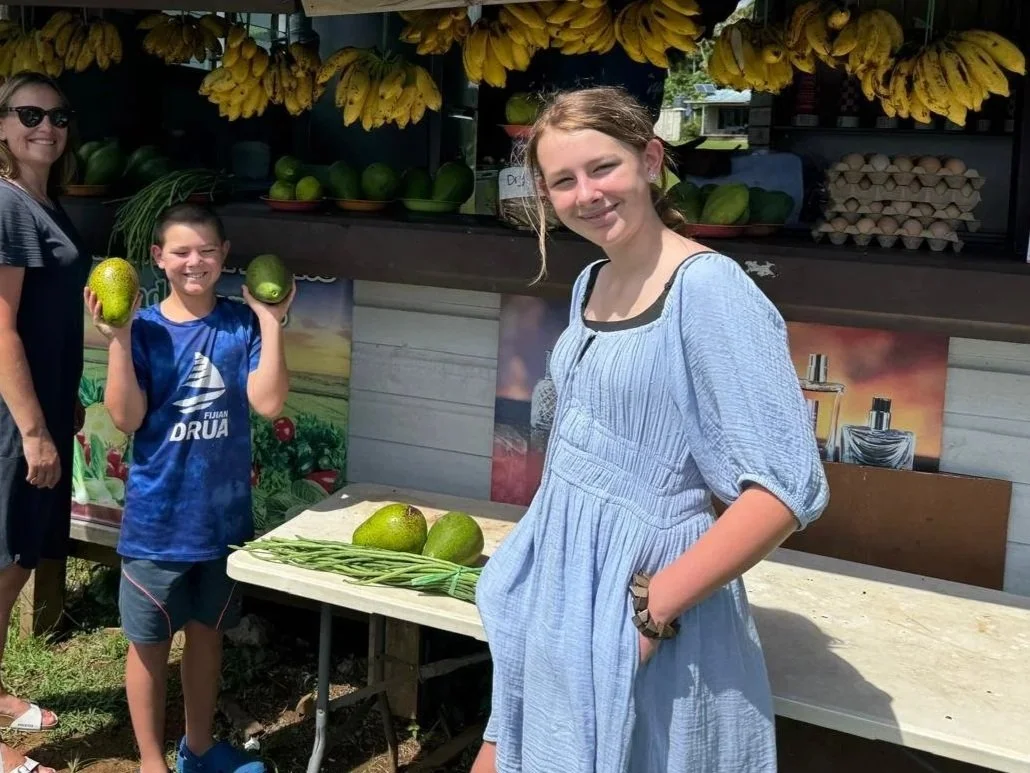
The menu varies depending on the season and what is available locally — fresh fish caught that morning, vegetables from the Naqara market, whatever fruit is in season on the property. There is no fixed menu, because a lovo has never been about a fixed menu. It is about what the land and the sea provide, prepared with care.
When the food is ready, the pit is opened. This is its own moment. The feast is served on the deck at Ucuilagi, with the Somosomo Strait spread out below and the evening light coming off the water.
“The best was of course the lovo and kava ceremony they prepared and performed for us. We felt so special. The food was delicious. The timing was right to even see Pini and family perform some of their local dances nearby.”
How the evening unfolds
Preparation in the gardens
Isoa and his family arrive and begin preparing the pit. The fire is lit, the stones are heated, and the food is wrapped in banana leaves. Guests can watch from the garden or the deck. There is no obligation, but most people find themselves drawn in.
The pit is covered and left to cook
Once the food is placed on the stones and the pit sealed, there is a natural pause of an hour or two: time to swim, sit on the deck, or simply enjoy the property while the feast cooks slowly underground.
The meke
If guests have arranged a meke alongside the lovo, Isoa's family and community members from Wiwi settlement perform traditional Fijian song and dance on the property. The meke can be arranged as part of the evening or separately. Ask Isoa on arrival.
Opening the pit
The pit is opened and the food brought up. This is its own small ceremony: the steam, the smell, the unwrapping of banana leaves. Everything arrives together, the way a feast should.
The feast on the deck
Dinner is served on the deck with the Somosomo Strait below and the evening sky above. Fresh fish, root vegetables, whatever is in season. The kind of meal that is impossible to replicate anywhere else.
Kava: what it is and how to try it
Kava, known in Fiji as yaqona, is a drink made from the dried and ground root of the kava plant. It has a mildly earthy, slightly bitter taste and produces a gentle numbing of the lips and a calm, unhurried feeling that Fijians describe simply as relaxed. It is non-alcoholic and has been central to Fijian ceremony, hospitality, and social life for centuries. No formal gathering in Fiji happens without it.
At Ucuilagi, Isoa grows and dries kava on the property. If guests want to try it (and most who visit Fiji at least once should), Isoa can prepare a bowl and explain the ceremony around it. It is not part of the lovo by default, but it is always available to arrange. The kava ceremony involves sitting cross-legged in a circle, clapping once before receiving the bowl, drinking it in one go, and clapping three times after. The ritual is simple and the welcome behind it is genuine.
On kava
Kava affects people differently. Most guests feel a mild relaxation and a pleasant numbness around the mouth and throat. The effect is subtle rather than dramatic, and it wears off within a couple of hours. It is safe to try, widely celebrated across the Pacific, and one of those experiences that makes a visit to Fiji feel genuinely different from a holiday anywhere else.
The meke: Fijian song and dance
A meke is a traditional performance of Fijian song and dance in which stories are told through movement, rhythm, and voice. The men's meke, the war dance or cibi, is powerful and percussive. The women's meke is more graceful, performed seated, with hand and arm movements that carry the story. Both are genuinely moving to watch in person, in a way that a staged resort performance rarely captures.
At Ucuilagi, the performers are members of Isoa's family and community from Wiwi settlement, the village where his mother and sisters still live. This is not a professional troupe hired for the occasion. These are people for whom the meke is part of their own history and identity, performing it in the gardens of a property they know well. That context changes the experience considerably.
The meke can be arranged alongside the lovo or as a separate evening. Ask Isoa on arrival. He will advise on timing and what is possible during your stay.
Visiting a Fijian village
Beyond what can be experienced at Ucuilagi itself, Taveuni offers genuine opportunities to visit working Fijian villages: communities where traditional life continues largely as it has for generations. A village visit requires a small amount of preparation and a willingness to follow local custom, but it is one of the most rewarding things a visitor can do on the island.
The essential customs: bring a small bundle of kava root (yaqona) as a sevusevu, a gift of respect presented to the village chief on arrival. Dress modestly: knees and shoulders covered for both men and women. Remove shoes before entering any building. Remove hats and sunglasses in the village. Do not touch anyone on the head, and do not point with your feet. If you are invited to sit, sit cross-legged if you can.
Sunday mornings are a particular occasion worth planning around. Fijian choral singing in a village church is genuinely extraordinary: full-voiced, harmonised, and completely unaffected by an audience. Visitors are welcome at Sunday Mass. Dress respectfully and arrive in time for the service. The singing alone is worth the trip.
Isoa can advise
On the best villages to visit during your stay, when and how to go, and what to bring. His connection to the community on Taveuni runs deep, and his guidance is the most reliable source of local knowledge available.
Arranging a lovo or meke at Ucuilagi
Both the lovo and the meke are arranged directly with Isoa on arrival at Ucuilagi. He will advise on timing, what is involved, and what options are available during your specific stay. As the food for the lovo is sourced locally and seasonally, a day or two of notice is helpful, but Isoa is experienced at making it happen and will do his best to accommodate whenever it is requested.
There is no fixed price published here, as it varies depending on the group size and what is arranged. Ask Isoa directly and he will give you an honest answer.
Ready to experience Taveuni?